 Add to Chrome
 Add to Firefox
 Add to Edge
Supervised Deep Multimodal Matrix Factorization for Interpretable Brain Network Analysis
May 13, 2026
We present Supervised Deep Multimodal Matrix Factorization (SD3MF), an interpretable framework for integrative brain network analysis that generalizes Symmetric Nonnegative Matrix Tri-Factorization (SNMTF) from unsupervised single-graph clustering to supervised prediction over populations of multimodal graphs. SD3MF learns deep hierarchical factorizations for each modality together with a shared latent representation that aligns subjects across views. An encoder-decoder formulation jointly optimizes graph reconstruction and supervised prediction, while adaptive weights enable data-driven multimodal fusion. By representing each subject through community-level interaction matrices, the model yields interpretable and discriminative features. Experiments on multimodal connectome datasets show that SD3MF consistently outperforms strong deep learning baselines such as CNNs and GNNs, while enabling biologically interpretable insights. Code for reproducibility is available at: https://github.com/amjadseyedi/SD3MF.

Towards a Virtual Neuroscientist: Autonomous Neuroimaging Analysis via Multi-Agent Collaboration
May 10, 2026Transforming neuroimaging data into clinically actionable biomarkers is a knowledge-intensive and labor-intensive process. Standardized workflows such as fMRIPrep have improved robustness and efficiency, but they are statically configured and cannot reason about downstream objectives, deliberate over alternative strategies, or close the loop between intermediate evidence and subsequent decisions in the way a human researcher would. This lack of closed-loop adaptation often leaves domain experts trapped in a cycle of manual trial-and-error to tune parameters and remediate pipeline failures, severely constraining the scalability of clinical biomarker development. To bridge this gap, we introduce NIAgent, a multi-agent system for autonomous end-to-end neuroimaging analysis. Unlike conventional flat tool-calling agents, NIAgent adopts a code-centric execution paradigm where specialist agents collaboratively synthesize and optimize executable programs over composable domain-specific primitives. This design enables robust, long-horizon workflow construction that adapts dynamically to runtime observations. Furthermore, we propose a hierarchical verification framework for autonomous quality control, integrating cohort-level metric screening with agentic visual inspection to drive evidence-grounded workflow remediation. Experiments on ADHD-200 and ADNI demonstrate that NIAgent outperforms standard workflow-based baselines in predictive performance while exhibiting sophisticated agentic behaviors, including strategy exploration and adaptive refinement.
MedGPT-oss: Training a General-Purpose Vision-Language Model for Biomedicine
Mar 01, 2026Biomedical multimodal assistants have the potential to unify radiology, pathology, and clinical-text reasoning, yet a critical deployment gap remains: top-performing systems are either closed-source or computationally prohibitive, precluding the on-premises deployment required for patient privacy and PHI compliance. We introduce MEDGPT-OSS, an open-weight, 20B-parameter generalist vision-language model designed to facilitate open research in clinical AI. Rather than relying on architectural complexity, MEDGPT-OSS pairs the GPT-oss language backbone with a visual front-end via a optimized, three-stage training curriculum. By progressively domain-adapting these modules through rigorous data curation and long-context multimodal alignment, we demonstrate that a 20B model can bridge the capacity gap. It successfully outperforms larger open medical models on out-of-distribution (OOD) multimodal reasoning and complex text-only clinical tasks. By unifying diverse modalities under a single instruction-following interface, MEDGPT-OSS maintains a parameter-efficient footprint fully compatible with commodity GPUs. We release the complete training recipe, open-weight checkpoints, and a rigorous evaluation harness to serve as a verifiable foundation for privacy-preserving, institution-specific clinical AI research.
Segment Anything for Video: A Comprehensive Review of Video Object Segmentation and Tracking from Past to Future
Jul 30, 2025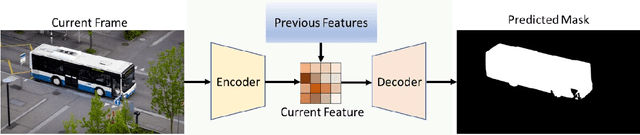
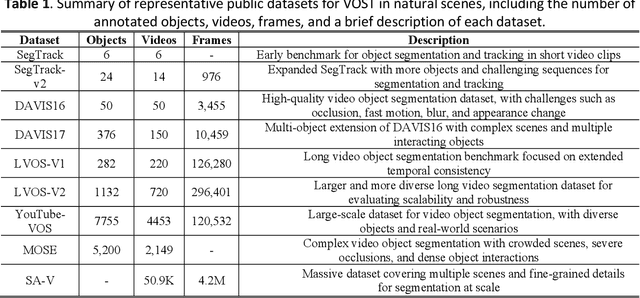
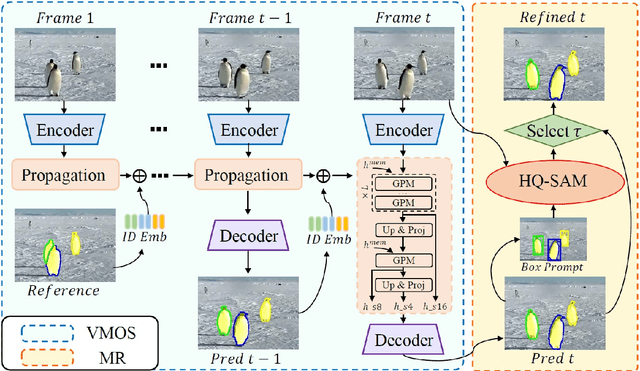
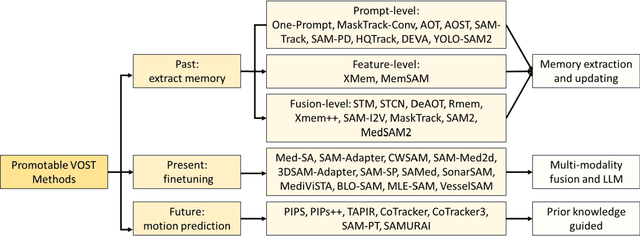
Video Object Segmentation and Tracking (VOST) presents a complex yet critical challenge in computer vision, requiring robust integration of segmentation and tracking across temporally dynamic frames. Traditional methods have struggled with domain generalization, temporal consistency, and computational efficiency. The emergence of foundation models like the Segment Anything Model (SAM) and its successor, SAM2, has introduced a paradigm shift, enabling prompt-driven segmentation with strong generalization capabilities. Building upon these advances, this survey provides a comprehensive review of SAM/SAM2-based methods for VOST, structured along three temporal dimensions: past, present, and future. We examine strategies for retaining and updating historical information (past), approaches for extracting and optimizing discriminative features from the current frame (present), and motion prediction and trajectory estimation mechanisms for anticipating object dynamics in subsequent frames (future). In doing so, we highlight the evolution from early memory-based architectures to the streaming memory and real-time segmentation capabilities of SAM2. We also discuss recent innovations such as motion-aware memory selection and trajectory-guided prompting, which aim to enhance both accuracy and efficiency. Finally, we identify remaining challenges including memory redundancy, error accumulation, and prompt inefficiency, and suggest promising directions for future research. This survey offers a timely and structured overview of the field, aiming to guide researchers and practitioners in advancing the state of VOST through the lens of foundation models.
Normative Modeling for AD Diagnosis and Biomarker Identification
Nov 15, 2024


In this paper, we introduce a novel normative modeling approach that incorporates focal loss and adversarial autoencoders (FAAE) for Alzheimer's Disease (AD) diagnosis and biomarker identification. Our method is an end-to-end approach that embeds an adversarial focal loss discriminator within the autoencoder structure, specifically designed to effectively target and capture more complex and challenging cases. We first use the enhanced autoencoder to create a normative model based on data from healthy control (HC) individuals. We then apply this model to estimate total and regional neuroanatomical deviation in AD patients. Through extensive experiments on the OASIS-3 and ADNI datasets, our approach significantly outperforms previous state-of-the-art methods. This advancement not only streamlines the detection process but also provides a greater insight into the biomarker potential for AD. Our code can be found at \url{https://github.com/soz223/FAAE}.
Regularized Kernel Recursive Least Square Algoirthm
Aug 28, 2015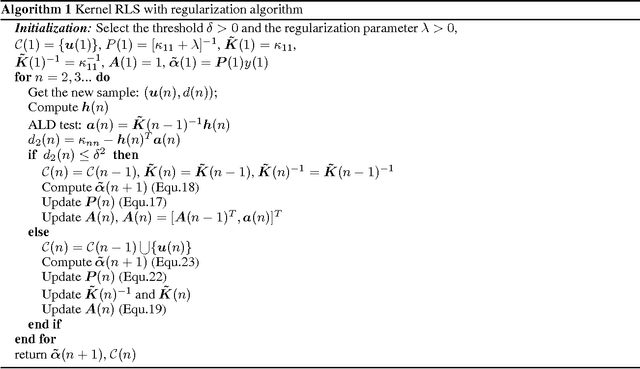
In most adaptive signal processing applications, system linearity is assumed and adaptive linear filters are thus used. The traditional class of supervised adaptive filters rely on error-correction learning for their adaptive capability. The kernel method is a powerful nonparametric modeling tool for pattern analysis and statistical signal processing. Through a nonlinear mapping, kernel methods transform the data into a set of points in a Reproducing Kernel Hilbert Space. KRLS achieves high accuracy and has fast convergence rate in stationary scenario. However the good performance is obtained at a cost of high computation complexity. Sparsification in kernel methods is know to related to less computational complexity and memory consumption.